

Compiled by: Leunell C. Monteza and Ian Jilchrist C. Empleo
- What is the difference between global warming and climate change?

“Global warming” refers to the long-term warming of the planet. Global temperature shows a well-documented rise since the early 20th century and most notably since the late 1970s. Worldwide, since 1880 the average surface temperature has risen about 1 °C (about 2 °F), relative to the mid-20th-century baseline (of 1951-1980). This is on top of about an additional 0.15 °C of warming from between 1750 and 1880.
“Climate change” encompasses global warming, but refers to the broader range of changes that are happening to our planet. These include rising sea levels, shrinking mountain glaciers, accelerating ice melt in Greenland, Antarctica and the Arctic, and shifts in flower/plant blooming times. These are all consequences of the warming, which is caused mainly by people burning fossil fuels and putting out heat-trapping gases into the air. The terms “global warming” and “climate change” are sometimes used interchangeably, but strictly they refer to slightly different things.
- Is the ozone layer causing climate change?
Yes and no. The ozone hole is basically a man-made hole in the ozone layer above the South Pole during the Southern Hemisphere’s spring. The ozone layer, which lies high up in the atmosphere, shields us from harmful ultraviolet (UV) rays that come from the sun. Unfortunately we punched a hole in it, through the use of gases like chlorofluorocarbons (CFCs) in spray cans and refrigerants, which break down ozone molecules in the upper atmosphere.
While some extra of the sun’s UV rays slip through the ozone hole, their net effect is to cool the stratosphere more than they warm the troposphere. So this increase in UV rays cannot explain the global warming of the planet’s surface.
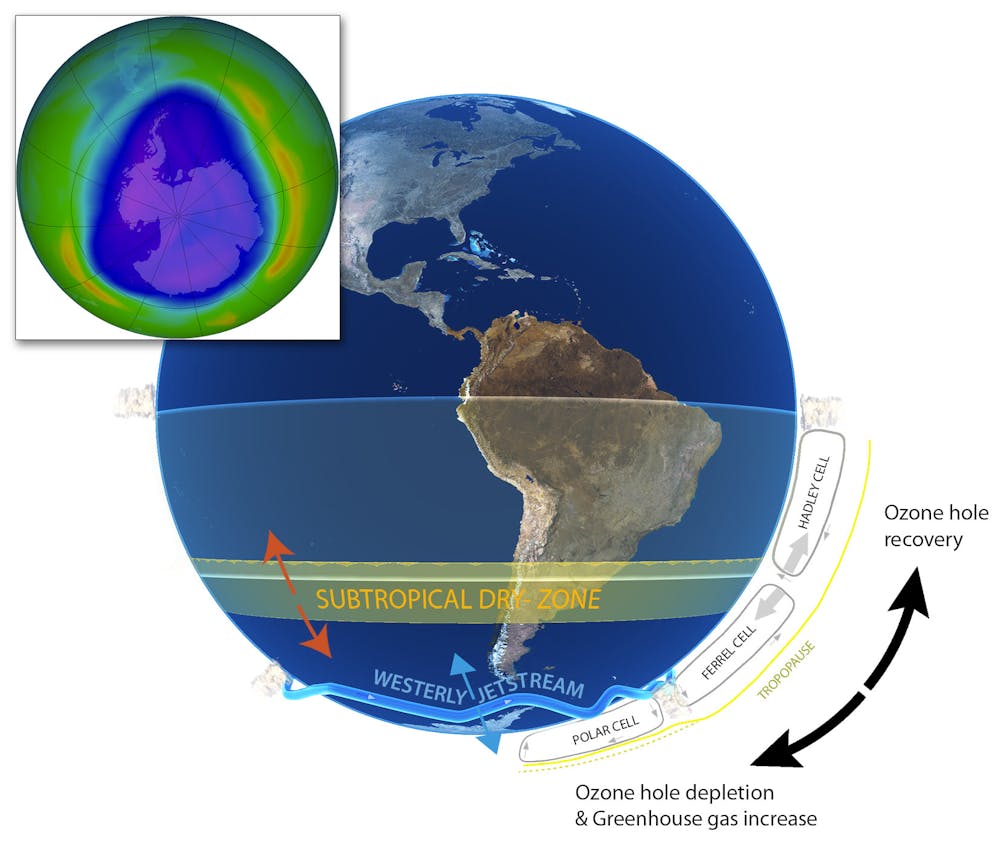
What scientists have uncovered recently, however, is that the ozone hole has been affecting climate in the Southern Hemisphere. That’s because ozone is also a powerful greenhouse gas, and destroying it has made the stratosphere (the second layer of the atmosphere going upwards) over the Southern Hemisphere colder. The colder stratosphere has resulted in faster winds near the pole, which somewhat surprisingly can have impacts all the way to the equator, affecting tropical circulation and rainfall at lower latitudes. The ozone hole is not causing global warming, but it is affecting atmospheric circulation.
- Is the sun causing global warming?
 No. The sun can influence the Earth’s climate, but it isn’t responsible for the warming trend we’ve seen over the past few decades. The sun is a giver of life; it helps keep the planet warm enough for us to survive. We know subtle changes in the Earth’s orbit around the sun are responsible for the comings and goings of the ice ages. But the warming we’ve seen over the last few decades is too rapid to be linked to changes in Earth’s orbit, and too large to be caused by solar activity.
One of the “smoking guns” that tells us the sun is not causing global warming comes from looking at the amount of the sun’s energy that hits the top of the atmosphere. Since 1978, scientists have been tracking this using sensors on satellites and what they tell us is that there has been no upward trend in the amount of the sun’s energy reaching Earth
- What is the greenhouse effect?

The greenhouse effect is the way in which heat is trapped close to the surface of the Earth by “greenhouse gases”. These heat-trapping gases can be thought of as a blanket wrapped around the Earth, which keeps it toastier than it would be without them. Greenhouse gases include carbon dioxide, methane and nitrous oxides.
Greenhouse gases arise naturally, and are part of the make-up of our atmosphere. Earth is sometimes called the “Goldilocks” planet – it’s not too hot, not too cold, and the conditions are just right to allow life, including us, to flourish. Part of what makes Earth so amenable is the naturally-arising greenhouse effect, which keeps the planet at a friendly 15 °C (59 °F) on average. But in the last century or so, humans have been interfering with the energy balance of the planet, mainly through the burning of fossil fuels that give off additional carbon dioxide into the air. The level of carbon dioxide in Earth’s atmosphere has been rising consistently for decades and traps extra heat near the surface of the Earth, causing temperatures to rise.
- Is it too late to prevent climate change?
Humans have caused major climate changes to happen already, and we have set in motion more changes still. Even if we stopped emitting greenhouse gases today, global warming would continue to happen for at least several more decades if not centuries. That’s because it takes a while for the planet (for example, the oceans) to respond, and because carbon dioxide – the predominant heat-trapping gas – lingers in the atmosphere for hundreds of years. There is a time lag between what we do and when we feel it.
But it may not be too late to avoid or limit some of the worst effects of climate change. Responding to climate change will involve a two-tier approach: 1) “mitigation” – reducing the flow of greenhouse gases into the atmosphere; and 2) “adaptation” – learning to live with, and adapt to, the climate change that has already been set in motion. The key question is: what will our emissions of carbon dioxide and other pollutants be in the years to come? Recycling and driving more fuel-efficient cars are examples of important behavioral change that will help, but they will not be enough. Because climate change is a truly global, complex problem with economic, social, political and moral ramifications, the solution will require both a globally-coordinated response (such as international policies and agreements between countries, a push to cleaner forms of energy) and local efforts on the city- and regional-level (for example, public transport upgrades, energy efficiency improvements, sustainable city planning, etc.). It’s up to us what happens next.
For more questions, please don’t hesitate to approach us. We would be more happy to hear from you.
 Take Action